My guide to Panoramic Photography
TL:DR I have been shooting panoramas for over a quarter century. Here’s what I learned along the way.
Table of Contents
Cropping
Back in the bad old days of film photography, the simplest way to yield a panorama was to take a photo using a wide-angle lens, then cropping the top and bottom of the frame away. Here is a shot of the Mont Saint Michel I took with my old Nikon 35Ti luxury point-and-shoot, which had a panorama slider switch that would enable this cropping in-camera.
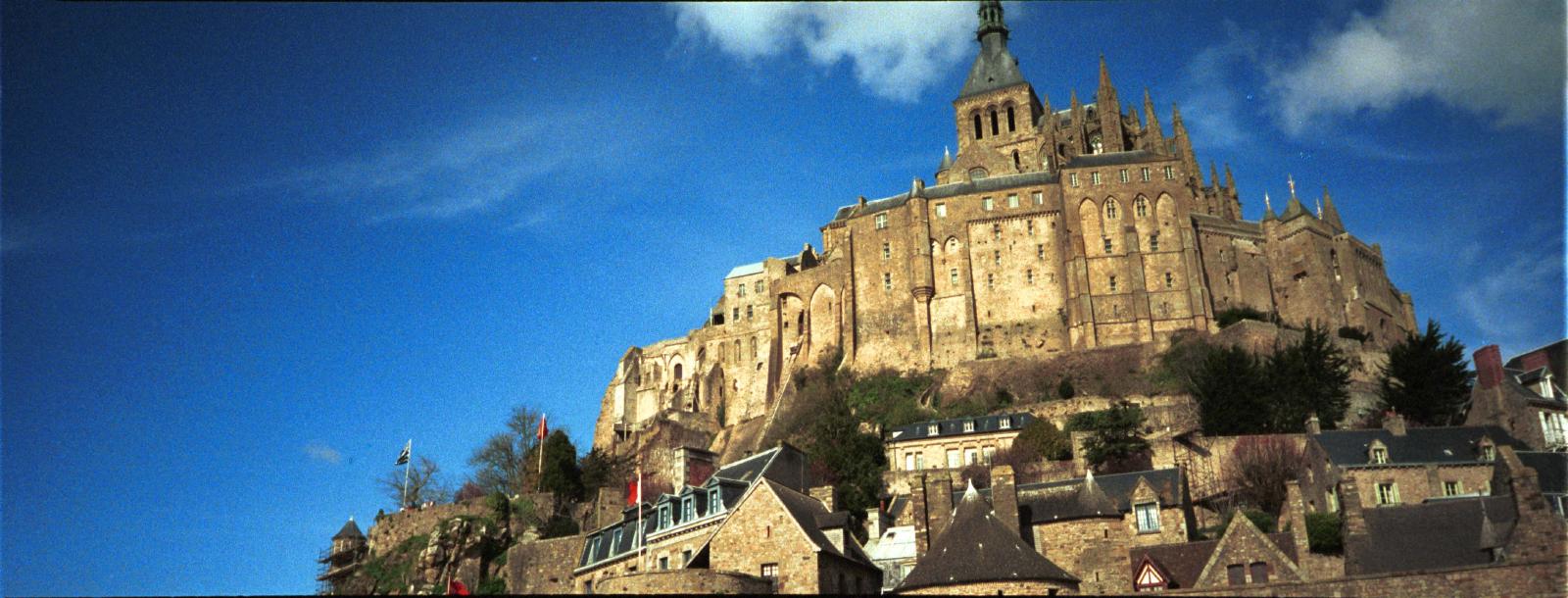
Photo minilabs of the day could make panoramic prints with a 3:1 aspect ratio. Obviously you throw away some image resolution and detail in the process, and the higher magnification meant grain was more apparent.
Phone camera apps
Nowadays of course, most regular people’s exposure to panoramic photography is through their smartphone camera app, which makes you rotate the camera slowly and uses the vast computational power of their CPU to stitch it together in near real-time. The results can be pretty good if you have a steady hand.
Most proper digital cameras sold today also have this feature built-in, as long as you accept losing the ability to shoot RAW.
Panoramic tripod heads
The first pano head I purchased was a Kaidan Kiwi+. It was fairly crude and not that well machined compared to what you can get from Manfrotto or ReallyRIghtStuff today
PocketPano
Gigapan Epic 100.
Benro Polaris
Rectilinear panoramic cameras
I have owned two rectilinear panoramic film cameras: the Hasselblad X-Pan II (made by Fuji and also known as the Fuji TX-2 in Japan) and the Fuji G617. I have never owned a Widelux or Noblex type camera that works by rotating a lens across the frame, however. Actor Jeff Bridges is attempting to reboot the Widelux.
The X-Pan and X-Pan II were outstanding cameras, with a build quality that made a Leica MP feel insubstantial. The lens aperture click stops were a thing of beauty.
The G617 (and its interchangeable-lens sibling the GX617) were large-format cameras masquerading as medium-format ones, shooting a huge 6x17cm negative or slide which corresponds to a crop of a 5x7 negative, and thus using large-format lenses, but using much more convenient 120 or 220 medium format roll film. A single roll of 120 film could only hold 4 frames… These were imposing cameras meant to be used on a tripod, but I’ve known photographers like Mark Denton who used them handheld. Mainstream production of these cameras ended two decades ago, but there are hobbyist efforts, often 3D-printed.
Scanning such wide negatives was a challenge. You could use a flatbed scanner, but their optics capable of at best 1000 ppi resolution are inadequate for the extremely high quality lenses, as I recount in my article on loupes and so I had also purchased a Nikon Super CoolScan 9000 ED medium-format film scanner and the specialized medical slide film holder that could actually hold a 6x17 frame without it drooping thanks to the anti-Newton glass in the holder.
Since professional film scanners have gone the way of the dodo, there are no real prosumer options left for scanning 6x17 film even if you buy one of the few 6x17 camera models still made, you would need to settle for a flatbed scan (and even the Epson V850 has been discontinued due to lack of availability of linear CCD sensors) or find one of the dwindling number of service bureaus that still have drum scanners.
360° cameras
Ricoh revolutionized the field when they launched the Theta in 2013. I’ve owned nearly every model in that line they released since, up to the first-generation Theta Z1. I also have a DJI Osmo 360 with a similar design.
These cameras operate by having two 180° fisheye lenses on either side of the camera, each with its own sensor, taking in half of the total field of view. Software inside the camera stitches the two halves into a single 360° panorama. Since both lenses shoot a single frame, there is no risk of ghosts.
Insta360 makes a number of well-regarded 360° cameras (I have never owned one). They went one step up with the Antigravity A1 quadcopter that has a 360° camera instead of the usual gimbal-mounted wide-angle.
Gimbal cameras
Gimbal cameras like the DJI Pocket or the Insta360 Luna Ultra are the spiritual successors of the camcorder. The fact the gimbal can orient in nearly every possible direction makes them like a panorama head and camera combined in one, and indeed, they all have a panorama feature, the Luna Ultra can take 200MP panoramas usin 24 stitched frames, albeit not full 360°. This resolution is much higher than that of the dual-fisheye cameras that can do around 30MP, but otherwise is no different from other stitched panoramas, including the risk of ghosting.
Printing
Web publishing
Aframe
Marzipano
VR Goggles
Exotica
Seitz Roundshot
Matterport